The Star Trek Chicago '75 film premiered on YouTube, Feb 19 2010. Since then, It has been picked up by many Sci-fi related sites around the globe. "This convention was attended by the entire cast and may the reason for the video's popularity", says Rich Portnoy who filmed the event. "The fan response has been incredible", noting the barrage of comments on YouTube and personal emails, "One pointed out that David Gerrold, author of The Trouble with Tribbles, is the one kissing Nichelle Nichols". "I was also contacted by members of the The Dorsai Irregulars", Rich referring to the ones dressed like Klingons, "Turns out, they're a hardworking band of SciFi fans who [still to this day] provide operation support and crowd control for similar events." The number of views have now exceeded 22,000.
We wish to thank the following sites for making this video a success:
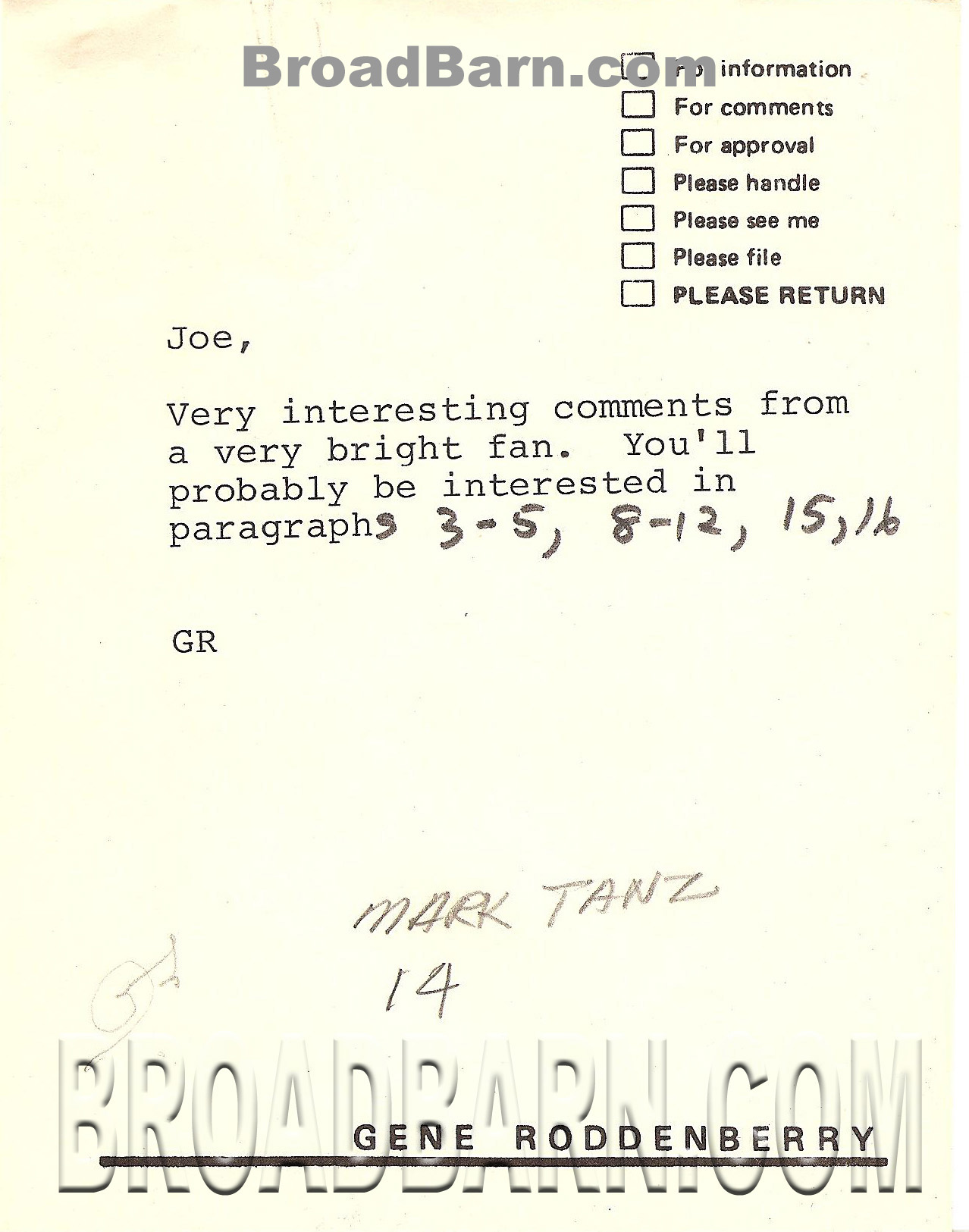
BroadBarn acquired this document from the Profiles in History auction house. It is a letter to Gene Roddenberry from a fan of the original Star Trek series. Gene thought enough of this letter to send it to Joe Jennings, Art Director of Star Trek, The Movie. For what may be the first time ever, the entire fan letter along with the note to Joe are being displayed to the public.
The Note to Joe from Gene is regarding a letter from an astute Star Trek fan. There appears to be enough clues in the fan's letter to Gene to pinpoint the time it was written. If anyone can decipher those clues, please suggest the date it was authored.
The note to Joe Jennings may have been sent sometime prior to the production of the first Star Trek Movie, for which Joe was the Art Director. The fan letter could have been written several years earlier.
August 25th, 2010 23:48:16 EDT -0400 CERN at night
It’s 5:38 AM. Do you know where we physicists are?
Right now I’m on a test beam shift for the ALICE electromagnetic calorimeter (EMCal). The test beam delivers particles at a fixed momentum – right now a mixture of 60% electrons and 40% pions at 10 GeV/c. We have a miniature version of our EMCal, 64 towers (8×8) complete with read out electronics. It’s positioned in front of the beam line so that we can measure the response of the EMCal to these particles. We move the beam around on the detector so that we can see the response of each tower to the beam. We also try different momenta.
We have about a week to use the test beam and we want to make the most of our time, so we take shifts around the clock. This is where I am right now:
The building to the right – the barracks – is where we sit when we take data. Our little detector is to the left, behind the large cement blocks. The cement blocks are there to shield people in the hall from radiation from the beam. The beam comes from the far end of the hall. The cables take data from our detector to the barracks.
And we are not alone – there are several other groups using data from the test beam and doing other experiments right now. The lab that never sleeps. Our test beam comes from the Super Proton Synchrotron – once the highest energy accelerator in the world and now both the injection source for the LHC and the beam source for multiple ongoing experiments.
August 23rd, 2010 23:48:16 EDT -0400 Sorry, can you repeat that?
This post is meant to have a positive tone. Really.
The LHC experiments all rely heavily on some form of teleconferencing to get their work done. As experimental collaborators number in the thousands, we can’t get by without conversing with each other. And with collaborators all over the world, we can’t expect people to physically appear at every single meeting. This could work fifteen or twenty years ago, when people typically participated in experiments on the regional or national scale. I know a whole fleet of professors who used to drive a car or take a plane to Fermilab once every two weeks, or even every week, so that they could be in the room for some particular meeting. Now that we are spread over so many miles, it seems too much to ask. But teleconferencing has allowed us to move past that era. It is absolutely not as good as being there in person, but given the monetary costs of moving people around, and the amount of people’s time that can be wasted in transit, not to mention the wear and tear on all of us when we are away from home, it makes sense to take advantage of teleconferencing technology.
The good news in all this is that we have reached a point in teleconferencing technology where anyone who has a computer with a microphone, speaker and network connection can take part, from any office that they might be sitting in, making teleconferences much more convenient than ever before. The bad news, of course, is that we have reached a point in teleconferencing technology where anyone who has a computer with a microphone, speaker and network connection can take part, from any office that they might be sitting in. Not all microphones are of such high quality. Some microphones tend to be rather close to computer speakers. Some connections are unreliable and have limited bandwidth.
So today I found myself on yet another conference in which we had to remind people to mute because we were hearing other speakers echo through their sound pickup, and had to work our way through some parties becoming inaudible or distorted at times, and had to listen to the occasional background conversation, and had to ask people to repeat themselves, a little louder please. It is, honestly a bit of a drag. I’ll admit that I pine for the days when you really just could sit around the table with a couple of co-workers and point at the plots in your notebook and be done with it.
But this post has a positive tone, really. I just try to keep in mind that yes, we are able to work with people who are scattered all around the globe, and actually get things done, thanks to this technology, even though it gives me fits.
August 20th, 2010 23:48:16 EDT -0400 Off to Geneva
I’m off to Geneva for a couple of weeks. While I’m there I’ll work on the test beam for the ALICE electromagnetic calorimeter. I’ll tell you more about that in the next posts. But I thought I’d share with you the contents of my long trip survival kit:
A travel pillow, a bandana (which serves both as an eye mask and a lazy hair style), an outlet adapter, a netbook and mini-optical mouse, ear plugs, an mp3 player with a 30 hour battery, a hair brush and extra hair bands, two change purses (one for Euros, the other for Swiss Francs) and little mini-toothbrushes with toothpaste already on them. I don’t deal with sleep deprivation very well so these flights are never very fun – but they’re easier to take than flights between the US and Asia.
August 20th, 2010 23:48:16 EDT -0400 Month-long Vacations in France
Workers in France are guaranteed at least 5 weeks paid vacation time each year.[1,2] Many people take that time off in the month of August. I don’t know how August became the vacation month, but that’s the way it is. Hours for many stores become even more limited or simply close – for the month!
Even in my hometown of Madison, WI there is a French bakery owned by a french family and they close up shop for most of August.
The disappearing of French workers also happens at CERN – professors, scientists, etc, many of them are gone. That leaves the rest of us with the chance to either get ahead in our work, or relax and take it easy as well.
(Oh, and did I mention that the French also have a 35-hour work week?[3])
Don’t worry though, the LHC is still on and they’re trying to reach higher beam luminosities. At the moment they’re working on some cryo problems:
September 3rd, 2010 15:24:01 EDT -0400 Earl (North Atlantic Ocean)
NASA satellites and the International Space Station are keeping eyes on Hurricane Earl as it heads for New England. more...
September 3rd, 2010 15:24:01 EDT -0400 Fiona (Atlantic Ocean)
NASA satellite data has noticed that Tropical Storm Fiona is getting "longer" ... indicating that she's weakening ... more...
September 3rd, 2010 15:24:01 EDT -0400 Gaston (Atlantic Ocean)
Tropical Depression Nine strengthened yesterday into Tropical Storm Gaston, but today it ran into dry and stable air and weakened back into a depression again. more...
September 3rd, 2010 15:24:01 EDT -0400 Tropical Depression 10E (Eastern Pacific Ocean)
The tenth tropical depression of the eastern Pacific Season formed on Sept. 2, and is maintaining its strength. more...
September 3rd, 2010 15:24:01 EDT -0400 Malou (Northwestern Pacific Ocean)
The Pacific Ocean seems to be developing the same number of tropical depressions at the same time in both the Eastern and Western North Pacific Ocean ... more...
NASA News
September 3rd, 2010 15:24:01 EDT -0400 NASA Sets Briefing About Assistance To Trapped Miners In Chile A NASA team sent to Chile to aid trapped miners will hold a news conference about their work at the San Jose gold and copper mine near Copiapo at noon CDT, Tuesday, Sept. 7. more...
September 3rd, 2010 15:24:01 EDT -0400 Space Station Crew Talks With Students At Florida Science Center Students and teachers at the Pinellas County Science Center in St. Petersburg, Fla., will have an out-of-this-world phone conversation with NASA astronauts aboard the International Space Station. more...
September 3rd, 2010 15:24:01 EDT -0400 NASA Selects Investigations for First Mission to Encounter the Sun NASA has begun development of a mission to visit and study the sun closer than ever before. more...
September 3rd, 2010 15:24:01 EDT -0400 NASA Invites Media To Experience Future Of Human Space Exploration To see what life might be like on a distant planet, reporters need only travel to the Arizona desert. more...
September 2nd, 2010 15:24:01 EDT -0400 NASA, Newseum Invite Media To Discover And Encounter Comets NASA will commemorate a quarter-century of comet discoveries and discuss upcoming comet encounters during a symposium at 9 a.m. EDT on Friday, Sept. 10, in the Knight Studio of the Newseum. more...
NASA pic of the day
Fri, 03 Sep 2010 00:00:00 EDT A Chameleon Sky
The sands of time are running out for the central star of this the Hourglass Nebula. With its nuclear fuel exhausted, this brief, spectacular, closing phase of a sun-like star's life occurs as its outer layers are ejected and its core becomes a cooling, fading white dwarf. In 1995, astronomers used the Hubble Space Telescope to make a series of images of planetary nebulae, including the one above. Here, delicate rings of colorful glowing gas (nitrogen-red, hydrogen-green, and oxygen-blue) outline the tenuous walls of the 'hourglass.' The unprecedented sharpness of Hubble's images revealed surprising details of the nebula ejection process and may resolve the outstanding mystery of the variety of complex shapes and symmetries of planetary nebulae. Image Credit: NASA, WFPC2, HST, R. Sahai and J. Trauger (JPL)